


Hosted by and recorded at Askeaton Contemporary Arts (ACA) in August 2020
Participants: Michele Horrigan, Suza Husse, Emma Wolf-Haugh, Sean Lynch, and Lívia Páldi
Moderation and co-editing: Suza Husse
Recording and sound editing: Nat Schastneva
Co-produced by Askeaton Contemporary Arts and Project Arts Centre, Dublin
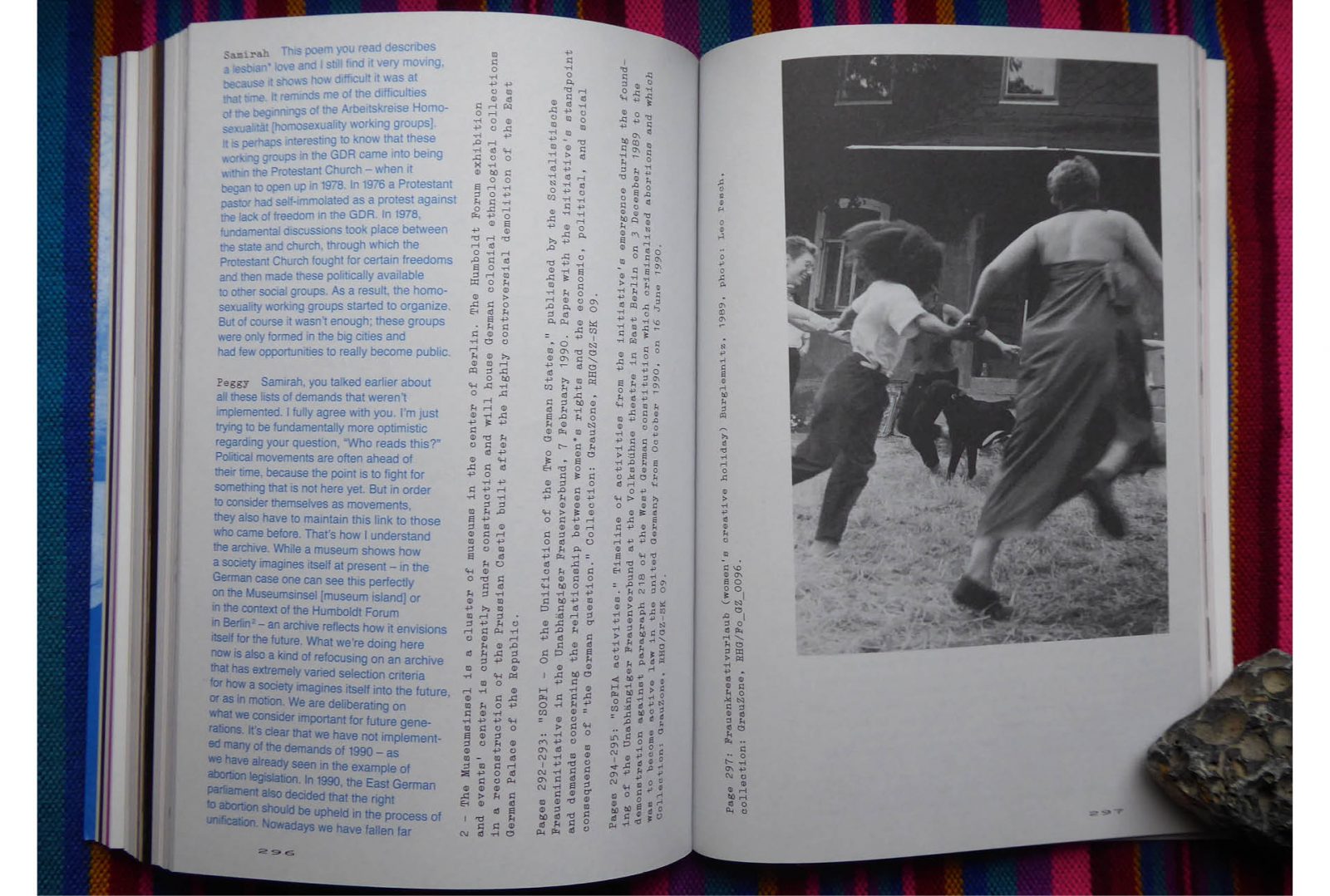
Prepared during the first lockdown in spring 2020, Active Archive–Slow Institution: wild recuperations. material from below: a conversation explores the different considerations involved when working with archives, and the often overlooked, marginalised histories. Each of the speakers was invited to reflect on texts from the publication wild recuperations. material from below, Dissident Stories between GDR and pOstdeutschland,[1] from the perspective of their own practices and researches.
wild recuperations is the result of a multi-year transdisciplinary research process that brought artists, researchers, writers, curators, archivists, activists, and multiple interlocutors together at the Archive of the GDR Opposition in Berlin. The materials gathered there draw a complex picture of individual and collective lives that deviated from repressive social norms, as well as the environmental, feminist, and grass-roots democratic practices and radical proposals that took shape in response to the promises and failures of state socialism. Within our exchange, dissident archiving in the post-socialist and post-colonial German contexts were added to a conversation centred on the divergent histories of queer*feminist living and organising, and eco-politics in Ireland. wild recuperations continued as a method for making, connecting, imagining, and pluralising stories and materials from below, in order to connect different geographies, and artistic, research, and political practices.
Speakers and references:
Living by the river Deel as a temporary inhabitant of Askeaton during the global pandemic crisis, the curator/writer in residence at ACA Suza Husse acted as organiser and moderator. The conversation aimed to expand on the multi-year research/exhibition/publication project wild recuperations. Rooted in the collaborative research practices developed at the queer*feminist art space and cultural center District*School Without Center which Suza has co-shaped since 2012 as artistic co-/director, wild recuperations drew on ‘current artistic and political forms of working with archives and memory presenting a plurality of approaches from and across critical post-socialist, queer*feminist, Black, post-migrant, and intersectional perspectives’. While highlighting ‘positions from which histories are experienced, desired, and told – their situatedness in bodies, languages, and ecologies’, Suza introduces particular dissident materials unearthed by the project, aspects of its making, as well as the larger cultural contexts in which it resonates.
The project wild recuperations. material from below has contributions from Alex Gerbaulet + Mareike Bernien, Anna Zett, Elsa Westreicher, Elske Rosenfeld, Ernest Ah + Sabrina Saase + Lee Stevens of the Raumerweiterungshalle collective, Ina Röder Sissoko + Suza Husse, Irena Kukutz, Nadia Tsulukidze, Peggy Piesche, Samirah Kenawi, Technosekte + Henrike Naumann, and Katalin Cseh-Varga, Maria Josephina Bengan Making, Rebecca Hernandez García, Redi Koobak, Sebastian Pflugbeil and Tim Eisenlohr. It is ‘is part of an ongoing commitment to opening up space in which diverse imaginations and realities of alternatives to capitalism, patriarchy, colonialism, and nationalism can enter into nurturing relationships with the dissident heritage of the GDR (German Democratic Republic)’.
Suza’s quote
‘Only a multiplicity of stories will avoid historiography closing down into one normative story.’
–Samirah Kenawi, activist and archivist of the East German women*s movement, 1996[2]
Visual artist and curator Michele Horrigan leads us through the research work she has engaged in since 2011, which explores the histories and material culture of the world’s most versatile metal: ore bauxite, the mineral used in computer parts and engines, drink cans and airplanes, as well as in the aluminum industry near her hometown of Askeaton. Stigma Damages (an installation featuring archival material, photography, video, found artefacts, 2011–ongoing) explores the histories of industrial manufacturing, addressing the ecological and political-legal concerns around Ireland’s largest industrial complex near Foynes, County Limerick, the Aughinish Alumina refinery, currently operated by the multinational company US RUSAL.
For the last decades, a range of human and animal ill effects were linked to industrial pollution in the Shannon Estuary. The plant’s more recent development to extend the height of bauxite residue deposits, raises further issues about the significant risk it might mean for the River Shannon, its wildlife, and human habitats. Discussing the text ‘Waste Disposals and Landfill’ by Berlin-based artist Anna Zett, Michele also speaks about the making of her video What a feeling! (Video, 3:30 min, 2014) where she re-enacts (with Aughinish Alumina in the background) various dance scenes from the 1983 romantic US drama Flashdance, in which an aspiring dancer-protagonist works in the steel mill in Pittsburgh.
Michele’s quote
The landfill doesn’t remember anything.
Like the walled-in country of the GDR itself, the landfill is a place that is isolated from its environment, or at least it is supposed to be. On a landfill, the cycle of nature must be suspended, because wind and water coming into contact with the discarded material poses a risk of contamination. The landfill is expected to operate according to rules that fundamentally differ from the rules of ecology. It is based on the phantasm of isolation, on the utopian idea that there really can be something like a non-place on this earth. If isolating the landfill doesn’t succeed, the area that needs to be isolated expands further; after a few years it is not just to the site of the land- fill itself that must be isolated, but also nearby inhabited areas. There
are plans for an underground wall to be built in Bitterfeld-Wolfen, in order
to protect the Greppin district from poisonous ground water, which has been slowly but steadily creeping in its direction, as it says on the website of MDSE, the Mitteldeutsche Sanierungs- und Entsorgungsgesellschaft [Middle German Sanitation and Waste Disposal Society]. The concrete wall will be 35 meters deep and 650 meters long, and is supposed to completely stop the groundwater flow to Greppin. It is one of the many small, post-apocalyptic building projects in the east German provinces.
–Anna Zett[3]
Visual artist Sean Lynch expands on the making of Latoon (video 8’30”, various objects collected from motorways, 2006–15), his video work which focuses on the story of a particular whitethorn bush in Munster, Ireland, which is considered an important meeting place for supernatural forces of the region, namely aggressive fairies. In the 1990s, former broadcaster and folklorist Eddie Lenihan succeeded in getting Clare County Council and the National Roads Authority to change the route of the Ennis bypass to save the bush. The whitethorn is also referred to by the Irish name for a thorn, Sceach (or anglicised versions such as skeag, skeog, skea, skeagh or skagh). Lenihan is one of the few remaining and practicing seanchaithe, or traditional storytellers and lore keepers who, much like bards, memorise and preserve the oral traditions, history, and laws of the ancient Celtic culture. Similar to the fairy bushes, he is an ardent protector of ringforts, Ireland’s most common archaeological monuments. Spread throughout the countryside, tradition also associates these circular enclosures with fairies. Lynch connects us to his recent publication Men Who Eat Ringforts (ACA PUBLIC and Gaining Ground, a public art programme based in County Clare, 2020) that guides us through the exploration of the histories and specific sites with contributions from environmentalist Sinead Mercier, artist Michael Holly and Eddie Lenihan.
Sean’s quote
I am very interested in disrupting the narratives of ‘lagging behind’ or ‘catching up.’ I like to think of particular historical and contemporary activisms not along a hierarchizing temporal scale of progress, but in terms of the specific subjectivities they always both enable and disable in their own time. I am interested in a nonlinear chronopolitics of mutual denormalization. Looking back in time, it is always possible and necessary to challenge histories of resistance in terms of their shortcomings: where have present-day activisms and their languages increased the complexity of our understandings and helped to highlight and stop particular exclusions? What, in turn, can we say about the activist vocabularies and imaginaries
of the present, when we look at them from the perspective of historical activisms?
–Elske Rosenfeld[4]
As Curator of Visual Arts at Project Arts Centre, Lívia Páldi has initiated Active Archive–Slow Institution, a major research project and exhibitions that delve into Project’s rich 50+ year history, approaching it from pressing contemporary issues and situating it within the wider, cultural-institutional, political, and social contexts. The project has also become a wider framework to discuss the various ways and strategies of engaging with, presenting, and making alongside archives, and interrogating absent, marginalised, and subjugated histories. This research happens through a continuous interrogation of what is considered, framed and documented as knowledge, as well as competencies of inquiry and fields and positions of interpretation.
Lívia’s quotes
More than two years ago I started looking for documents and other finds in the archives of GDR memory to substantiate the experiences of contract workers and other BIPoC [Black, indigenous, and People of Color] friends in my life. Soon, we would be looking back on 30 years of German unification and would be making one date the focus of social discussions, conversations and, most of all, memories, a date which was turning into an anniversary. This type of anniversary never just carries the memory of a certain moment, but it marks an instance in which collective mentality is arranged and aligned anew, and in which values and directions can be re-negotiated. The collective sense of goosebumps generated by the so called “Peaceful Revolution” would become an important driver for the dominant mentality to re-legitimize itself.
–Peggy Piesche[5]
What interest me the most is the intersectional entanglement of history and collective memory. This Archive is really wonderful, because it represents a collective memory quite outside the mainstream. In some ways, it’s a miracle that it even exists. Yet, that doesn’t make it intersectional. In this light, how can we complicate our approach sufficiently to really acknowledge the gaps that are there? What might we have to do to bridge them, even with the memory practices that we already have?
–Peggy Piesche[6]
Visual artist and educator Emma Wolf-Haugh talkes about her experience and engagement as organizer, DJ in the queer, dyke DIY clubs and community-based theatre scenes, including the lesbian club ‘Libida’, the Irish drag king troupe called ‘the Shamcocks’ and the lesbian theatre company ‘The Other Stage’, which worked with techniques from Brazilian theatre practitioner Augusto Boal’s Theatre of the Oppressed. These engagements continue to inform her practice, which revolves around questions of spatial politics with a strong critical perspective alert to what is missing, and exposes cultural and historical blind spots and absences of queer women’s histories and sexualities. Emma ties in several references from queer writers and thinkers to elaborate on her selected quotes from wild recuperations.
Emma’s quotes
For lesbians, it was also a matter of making visible that a specifically female perspective does exist, and that an even more painful form of discrimination against lesbians arose from the way society deals with female homosexuality: the ignorance of it, the refusal to acknowledge it, and, the seeming non-discrimination that follows from this total erasure. This non-existence – not finding oneself reflected back anywhere, having no counterpart, no scale, no representation – in itself can lead to insanity
in a different way, to living toward nothingness.
–Samirah Kenawi[7]
So–when I say
Holes are conduits or a ‘means to’
Or a space or an intersection–
I mean holes are occasions–
Opportunities which can take
Many forms, materials, and durations
(imagine a hole that is only duration).
Excerpt from Pope L. Hole Theory (2002)[8]
Further quotes and references from Emma:
Research is taking our stories back.
–Jake Skeets: Eyes Bottle Dark with a Mouthful of Flowers [9]
Called by an injurious name, I come into social being, and because I have a certain inevitable attachment to my existence, because a certain narcissism takes hold of any term that confers existence, I am led to embrace the terms that injure me because they constitute me socially. The self-colonising trajectory of certain forms of identity politics are symptomatic of this paradoxical embrace of the injurious term.
–Judith Butler [10]
If language is an environment, that must mean words have a physicality and belong to an ecology, speech is a psycho-physical act that is produced by the body.
–Seabright D. Mortimer [11]
I believe in gratitude as a kind of discipline, an energising and potentially collectivising discipline, what I mean is that when I’m thinking of gratitude the gratitude I’m thinking of is largely about the ways we make each other possible. That gratitude makes me more interested in making people possible, myself included.
–Ross Gay [12]
Notes
[1] Elske Rosenfeld and Suza Husse, eds., wild recuperations. material from below. Dissident Stories from the GDR and pOstdeutschland #1 (Berlin: District*School without center and Archive Books, 2020).
[2] Suza Husse and Elske Rosenfeld, ‘Introduction,’ in wild recuperations, 12.
[3] Anna Zett, ‘Waste Disposal and Landfills,’ in wild recuperations, 84.
[4] Elske Rosenfeld and Suza Husse in conversation with Katalin Cseh-Varga, Rebecca Hernandez García, and Redi Koobak, ‘Dissident Stories from the GDR and pOstdeutschland. Resonances and Reflections,’ in wild recuperations, 227.
[5] Peggy Piesche, ‘Archive (of) Gaps,’ in wild recuperations, 140.
[6] ‘I want nobody to find no trace of our existence. A conversation and archival readings with Ernest Ah, Lee Stevens, and Sabrina Saase from the Raumerweiterungshalle collective, Elske Rosenfeld, Maria Josephina Bengan Making, Peggy Piesche, Rebecca Hernandez García, Samirah Kenawi, Suza Husse, and guests,’ in wild recuperations, 284.
[7] Samirah Kenawi in conversation, ‘Ties that went beyond an ordinary friendship,’ in wild recuperations, 127.
[8] Ina Röder Sissoko and Suza Husse, ‘Longing is my favourite material for engaging holes,’ in wild recuperations, 324.
[9] Between the Covers, podcast, https://tinhouse.com/podcast/jake-skeets-eyes-bottle-dark-with-a-mouthful-of-flowers/
[10] Judith Butler, The Psychic Life of Power: Theories of Subjection (California: Stanford University Press), 104.
[11] Seabright D. Mortimer, ‘Supermarket Revelations’ in Isabel Waidner, ed. Liberating the Canon: An Anthology of Innovative Literature (London: Dostoyevsky Wannabe, 2018), 176.
[12] Quoted by David Naimon, Between the Covers, podcast (no exact episode noted)
https://tinhouse.com/podcasts/
Institutions /organisations:
Since 2006, Askeaton Contemporary Arts commission, produce, and exhibit contemporary art in the locale of a small town in County Limerick, Ireland. An annual residency programme, Welcome to the Neighbourhood, situates Irish and international artists in the midst of Askeaton each summer, while thematic exhibitions, publications, and events often occur. Through these methods, over 100 artists projects have been realised.
District * School without Center is a queer feminist art space and cultural center in Berlin. Since 2009 they have been working as a place for development and reflection for artistic research and practice, critical educational work, trans*disciplinary cultural work, and anti-discriminatory knowledge and theory production. Grounded in intersectional, queer and decolonial approaches, District explores the curatorial as a performative and analytical practice, and probes new kinds of community. With a focus on locating artistic practice in the tensions between body and urban space, infrastructure and desire, ecology and performance, history and imagination, District develops collaborative and research-oriented formats.
Project Arts Centre (PAC) is a multi-disciplinary arts centre in Dublin that programmes, commissions, and produces work across all art forms from visual art, theatre, dance, and music to live art events, talks, and discussions.
You can read in the pdf attached: Elske Rosenfeld and Suza Husse in conversation with Katalin Cseh-Varga, Rebecca Hernandez García, and Redi Koobak, ‘Dissident Stories from the GDR and pOstdeutschland. Resonances and Reflections,’ in wild recuperations. material from below. Dissident Stories from the GDR and pOstdeutschland #1. Edited by Elske Rosenfeld and Suza Husse. Published by District*School without center and Archive Books, 2020
