


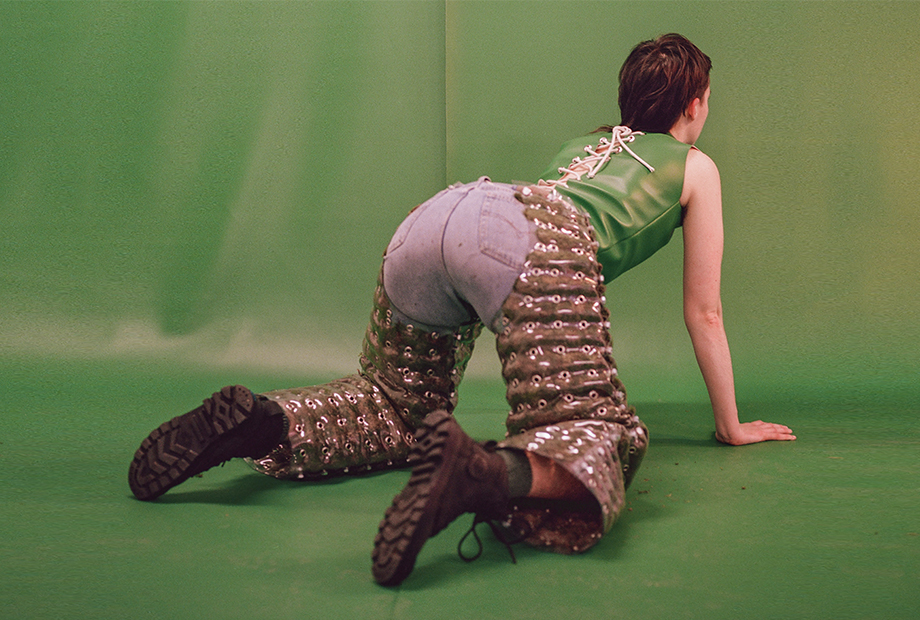
the middle of nowhere is a series of events that will unfold throughout February. Concerned with the subjectivity of space-making, the middle of nowhere will reveal itself in a hybrid form of in-person, remote and/or mobile experiences. Working with and through spatial perspectives, the middle of nowhere resists static concepts of space. In this manner, the vortex portal of the World Wide Web will host a variation of events. More transitionary spatial experiences will be embodied through one static billboard mounted outside Project Arts Centre, as well as one mobile billboard which will emerge alongside the launch of a publication. Project Arts Centre will act as a platform for the opening and closing events of the middle of nowhere. The initial opening event will consist of a one-off film screening and subsequently, the middle of nowhere closes with a one-off live performance.
~ ~ ~
My earliest recollections of self-identification stem not from queerness but rather from a sense of (dis)place(ment). This embodiment led me to question if space was a site of rooted and ‘authentic’ meaning. Ideals of identity as fixed in place were thus unravelled, undoing the static and dominant knowledge(s) of the self across time and space.
Mapping out the unmappable, the middle of nowhere seeks to criticise the increasingly reductive approach of stripping space of its complexities. This insistence of laying space bare, demonstrates the broader commitments to solidifying the predictability of lives that remain emblematic of the heteronormative mould. And thus, by (de-)centring the middle of nowhere, and contesting this common spatial perspective as Other, the site emerges as a counter normative place for individuals who do not relate to the dominant trajectory of place. From a queer perspective, the middle of nowhere reveals itself as an autonomous zone of desire, across which an unknowable self is dispersed. At odds with the closet and metaphors of ‘in’ and ‘out’, you are not defined by boundaries but rather speak to your capacities.
Situated in a natural landscape, the middle of nowhere emphasises how an alternative vision of natural phenomena can de-centre the rigid social order of racial capitalism’s prioritised dichotomy of gender and sexual binaries—a dichotomy that varies in definition from one historical and socio-cultural context to another. So, what grounds our conception of gender, sexuality and desire after nature?
Through a methodology of collaboration, the middle of nowhere actively de-centres the author and strives for multiplicity over a single queer narrative. Through this methodology, time and space become shared communal resources between an array of individuals as the parameters of ‘nowhere’ are resisted through a process of imagining how a collective might begin to live Otherwise. At its essence, the middle of nowhere is a transdisciplinary project, with a quest for building relations through which more equitable worlds can not only be imagined but sustained.
