


Sax, (No) Drugs & Rock N Roll
Bealtaine Festival
28 May 2026
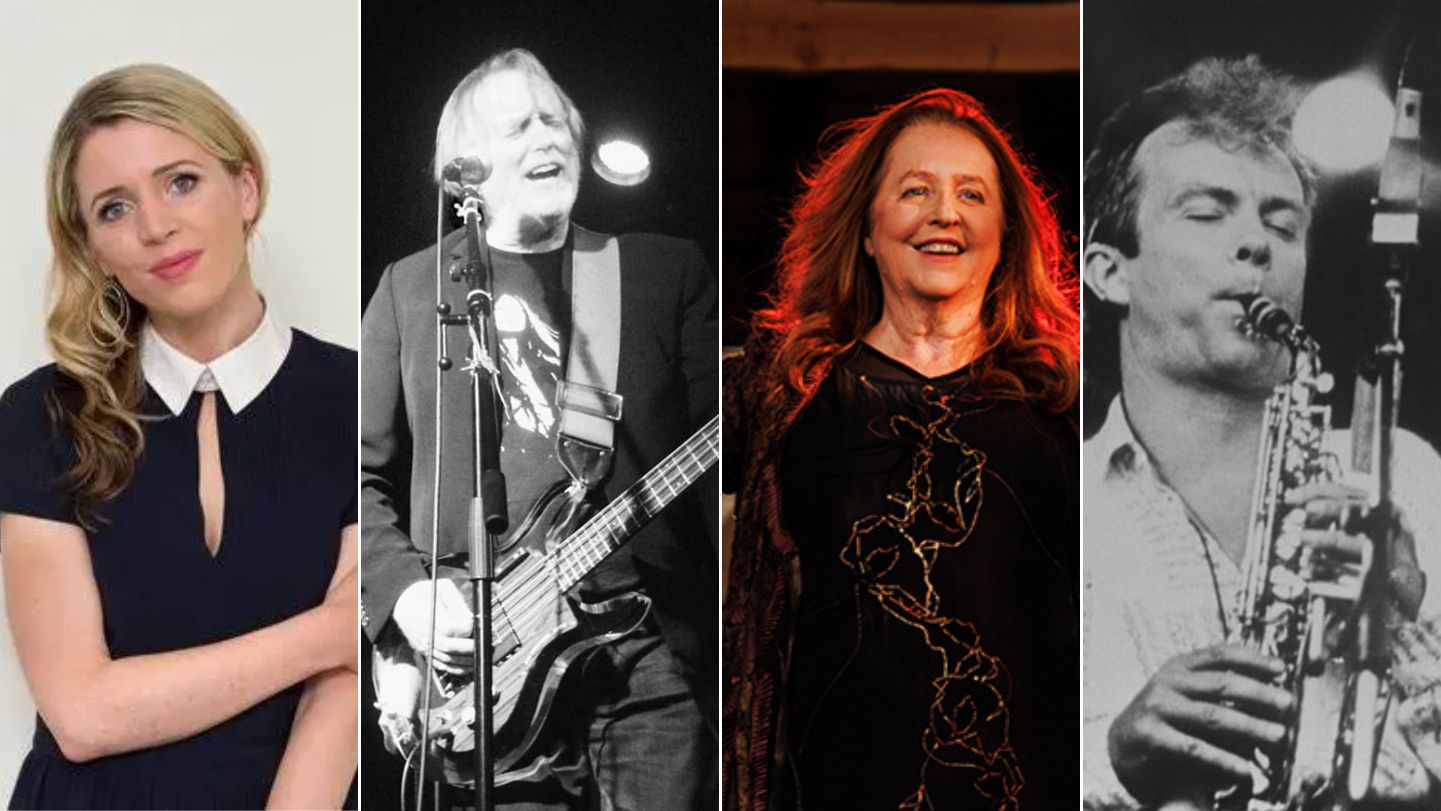
Cait (Caitlín) O’Riordan was born in Nigeria to Irish and Scottish parents, who moved to London when the Nigerian Civil War broke out in 1967. She heard The Nips song “Gabrielle” on the radio in 1979, and subsequently met Nips singer and future Pogues frontman Shane McGowan, who was working at Rocks Off Records where she went to buy the record. She left home in 1981, age 16, as soon as it was possible, and soon was invited by MacGowan to join his newly forming band Pogue Mahone as the bass guitarist. She owned a bass but had not played it until the invitation. She appeared on the group’s first two albums, Red Rose for Me and Rum, Sodomy and the Lash; the EP Poguetry in Motion and several early singles, before leaving in 1986. Besides playing bass, she provided vocals for ‘I’m A Man You Don’t Meet Every Day’ on Rum Sodomy & the Lash, and for ‘Haunted’ on the soundtrack of Alex Cox’s film ‘Sid and Nancy’. The Pogues’ most commercially successful song, ‘Fairytale of New York’ from ‘If I Should Fall from Grace’ was written as a duet for O’Riordan and MacGowan, but the band eventually recorded it with the late Kirsty McColl singing the female part.
In 1983, she became the singer in Darryl Hunt’s jazz band Pride of the Cross. Hunt was familiar to her as a roadie for the Pogues. During her time with Pride of the Cross, she sang lead on their only single, “Tommy’s Blue Valentine”. O’Riordan also acted in the 1987 Alex Cox film Straight to Hell, as the singing dancehall girl Slim McMahon, and also in the 1988 Frank Deasy film The Courier.
O’Riordan became romantically involved with Elvis Costello in 1985, while he was producing the Pogues’ album Rum Sodomy & the Lash; the relationship lasted 16 years. Her former Pride of the Cross bandmate Darryl Hunt filled in for her on several shows during the Pogues’ 1986 U.S. tour, and he replaced her permanently when she left later that year to join Costello on his King of America tour. She co-wrote the track “Lovable” from that album, and wrote, co-wrote, and appeared on songs on Costello’s subsequent albums Blood & Chocolate, Spike and Mighty Like a Rose. In 2004, she joined Pogues’ guitarist Phil Chevron’s reunited band The Radiators and also toured with the Pogues for the first time in 18 years.
In 2012, O’Riordan completed a BA in Psychology at University College Dublin, where she now lives. In 2018, O’Riordan joined Pogues tin whistle player Spider Stacy to perform Pogues songs under the name Poguetry, and in early 2020 played an eight date tour of the US. Since 2020, O’Riordan has hosted a weekly radio show, “The Rocky O’Riordan Show”, on U2-X Radio, an artist-branded channel which is part of SiriusXM.
Cáit admitted in 2008 that she had taken her last drink in February 2007 and will lead the conversation with fellow bass players Steve Travers (Miami) and Barry Devlin (Horslips).
About Barry Devlin
Barry Devlin is one of Ireland’s most celebrated creative artists working as a musician, screenwriter and director.
Born in Ardboe, Co. Tyrone in 1946, Barry initially trained as a Columbian but left to study English at University College Dublin before joining a graphics company as a screenwriter. Within the advertising world he met up with fellow musicians to write and perform radio jingles and this was the spark that became the legendary Irish trad rock band Horslips. The group, formed in 1970, are regarded as “founding fathers of Celtic rock” and went on to inspire many local and international acts.
Although Horslips packed out both concert halls and ballrooms in the 1970s, they had limited commercial success outside Ireland. The band resumed activity between 2004 and 2012, playing a small number of shows and producing new releases, both live and studio. They played their final shows in August 2012.
After the breakup of Horslips, Devlin released the 1983 solo album Breaking Star Codes. In December 1985, he produced the single “Thank You Very Much, Mr. Eastwood” for comedian Dermot Morgan. Devlin has directed projects for the screen plus a number of U2 videos in the 1980s. He has also written for radio and screen, originating the radio detective drama Baldi; created episodes for the television series Ballykissangel and Darling Buds of May plus the screenplay for A Man of No Importance (1984). He also wrote five episodes of the television series My Mother and Other Strangers, which aired in 2016.
Horslips reunited from 2004 – 2006, and again from 2009 – 2019. In November 2025, the band celebrated the 50th anniversary re-issue of Drive The Cold Winter Away. The acoustic album was originally recorded and released in 1975 in Dublin’s Trend Studios, engineered by Fred Meijer and produced by the band.
About Mary Coughlan
Mary is Ireland’s greatest jazz and blues singer and “one of our most openly raw performers” (Hot Press) and in a 40-plus year career, about to enter its next, exciting stage.
Born in Shantalla, Galway city, Mary has created and produced some of the most uncompromising, wholly personal, and universal music by any Irish artist. While her roots are in jazz and blues – Billie Holiday and Bessie Smith are among her inspirations – pop, rock, folk, and chanson influences (Edith Piaf is also a touchstone) also ripple throughout her work.
It was in 1985, when Mary burst onto the Irish music scene with her debut album, Tired and Emotional. That album led to appearances on The Late Late Show, a hit single with ‘Delaney’s Gone Back On The Wine’, and tours of Britain, Germany, and Holland.
She followed that explosive release with Under The Influence (1987), Uncertain Pleasures (1990), and Sentimental Killer (1992), which firmly established her reputation as an unflinchingly honest, emotionally raw vocalist, never afraid to embrace the most difficult of life and love subject matters in her work. As The Irish News said, she “doesn’t just take her audiences to church with her music, she practically baptises them with her passion and pain”. It was the same in her 2009 autobiography, Bloody Mary, where she documented addiction problems, relationship troubles, familial abuse, career mismanagement, suicide attempts, and dark days spent confined to psychiatric wards.
Despite the difficulties she encountered, the music kept coming with Live In Galway (1996), After The Fall (1997), Mary Coughlan Sings Billie Holiday (2000), Long Honeymoon (2001), The House Of Ill Repute (2008) and a ‘best of’The Whole Affair (2012), and Live & Kicking (2017).
Now sober for 30 years, the mother of five and grandmother of six, reached new peaks as a performer and songwriter with her most recent album, 2020’s acclaimed Life Stories. By turns powerful, swaggering, sexy, harrowingly raw, and deeply honest, Life Stories runs the full gamut of both music and emotions, from cabaret (‘High Heel Boots’) to late night jazz balladry (‘Elbow Deep’, ‘No Jericho) to some of the most exuberant pop oriented songs Mary has yet recorded (‘Forward Bound’, ‘Steps Forward’). Released via the artist’s own label, Hail Mary Records, it reached No 1 on iTunes and Amazon; garnered five star reviews and The Sunday Times Ireland said, “rarely has an album referenced a life so pointedly”, while The Daily Mail rightly wrote it was created by “a consummate talent at the top of her game”. To cap it all, in 2020, Mary was presented with a Lifetime Achievement Award by the then Mayor of Galway, Mike Cubbard.
Never one to sit still, Mary is now planning her most ambitious project to date. While she has covered Billie Holiday, Joy Division, and The Blue Nile in the past, she intends to reimagine the album Peggy Lee made with the pioneering rock’n’roll songwriters Lieber and Stoller, composers of such songs as ‘Hound Dog’ and ‘Jailhouse Rock’. The album, Mirrors, described by Allmusic.com as “intelligent, evocative, understated, and mature”, explored themes of murder, madness, despair, longing, and the rise of Fascism in the USA. Mary has been eager to work on this project for many years, but it was during lockdown that the opportunity presented itself. This has led to further work with musicians and visual artists to create what will be an immersive, multimedia, experience. A brilliant and unique career milestone to mark her fifth decade in music.
Mary will join Keith Donald (Moving Hearts) and Barry Devlin (Horslips) in an entertaining and wide ranging discussion exploring music, showbands, life on stage, addiction, abstinence, success plus the highs and lows of the road. Expect the true story!
About Keith Donald
Keith Donald’s career in music spans five decades and began with a recorder performance on BBC radio when he was ten. He is best known as the saxophonist with seminal Irish traditional band Moving Hearts, but his first love is jazz and he has never stopped playing live throughout his life.
Keith was born in Co. Derry in February 1945 and grew up in Belfast. His father was a banjo player in the 1920s and instilled in his two sons a passion for music. Keith fell in love with the sound of the clarinet and his school picked up the tab for his first instrument when he was twelve. It soon became clear that he had considerable natural musical talent and his mother bought him his first saxophone when he was fifteen, a Conn alto which he still has. In 1962 (aged seventeen) Keith played Mozart’s clarinet concerto with an orchestra and in the same year played the first Belfast Arts Festival with a jazz group, The Embankment Six. Unfortunately for Keith, The Beatles released their first single in 1962, heralding the advent of rock and roll in Belfast and consequently interest in jazz waned. Keith parked the clarinet, taught himself tenor sax and started playing commercial music.
Since then Keith has played with hundreds of artists, including, Noel Kelehan, Louis Stewart, Zoot Sims, Gerry Mulligan, Maire Breathnach, Ronnie Drew, Van Morrison and Vusi Mahlahsela. He has played recording sessions, advertising jingles and pit orchestra gigs, in addition to sold out auditorium shows, tiny jazz clubs and huge festivals. His musical career has taken him all over the world, from Johannesburg to New York and every major city in Europe. Keith also composes music for theatre, film and television including the saxophone soundtrack for Neil Jordan’s 1982 film Angel starring Stephen Rea. Keith was also part of the team that won a BAFTA award for United, a film which was conceived as a commentary on the divisive issue of parades in Northern Ireland politics. In addition he has composed music for BBC documentaries and the BBC film Great Journeys; co-composed the soundtrack for RTE/C4 film Summer Lightning, and written music for plays such as Frank McGuinness’ Carthaginians and Damian Gorman’s Sometimes.
After Moving Hearts ended, he was offered a new post in the Irish Arts Council, as Popular Music Officer, starting his final chapter as an arts administrator. This period also marked a serious decline in Donald’s alcoholism and after a drunken car crash, he finally attended an addiction support group meeting. His last alcohol drink was in 1991 and there the narrative ends.
In 2014 Keith wrote and performed a one-man play, NewBliss, which relates the story of his professional life, plus recounts the highs and lows of his six-decade long career, half of which was spent under the shadow of alcoholism. It is an insight into the life of a musician – from pit orchestra gigs to pay the bills, all the way through to sold out stadium tours.
Keith’s journey from addiction to redemption was also documented in his recently published memoir ‘Music & Mayhem’ – an acclaimed inspirational story, complete with both laughter and life lessons.
NOTE – Music & Mayhem will be on sale after the event and Keith will personally sign copies.
About Nadine O'Regan
Nadine O’Regan is an award-winning journalist, broadcaster, and podcaster. She is a staff writer with The Irish Times in the area of arts, features, and opinion, as well as travel editor for The Irish Times Magazine. In her work as a music and arts broadcaster, she has presented shows on RTÉ Radio 1, Phantom FM, and Today FM. From Skibbereen in Co. Cork, Nadine has an M.Phil. in Creative Writing from Trinity College Dublin. In 2023, her short story You was shortlisted for the RTÉ Short Story Competition in honour of Francis MacManus. She lives in Dublin with her husband Shane and son Oscar. Nadine is looking forward to exploring the extraordinary lives of three of Ireland’s most iconic musical trailblazers and delving deep into the highs and lows of the music business. A special audience Q&A is included.
About Age & Opportunity
Age & Opportunity is the national organisation working to enhance wellbeing for older people through participation in sport and physical activity, arts and creative engagement, personal development, community collaboration and active citizenship.
The Bealtaine Festival, an Age & Opportunity Arts initiative, is one of our flagship events. The festival continues to grow with the support and collaboration of our partners and hundreds of organisers throughout the country, as well as all those who attend a Bealtaine event. We are grateful to all those who organised events and look forward to another creative and inspiring year of Bealtaine Festival.
Funder Credits
Bealtaine Festival is an Age & Opportunity arts initiative funded by the Arts Council and the HSE.
Dates & Times
28 May
7:30pm
Tickets
€20
Space
The Cube
Duration
1 hr 30 minutes
Accessiblity
Open Captions
Genres
DiscussionFestivalMusic
https://vimeo.com/
Support Project Arts Centre and join us in developing the next generation of contemporary artists in Ireland
