


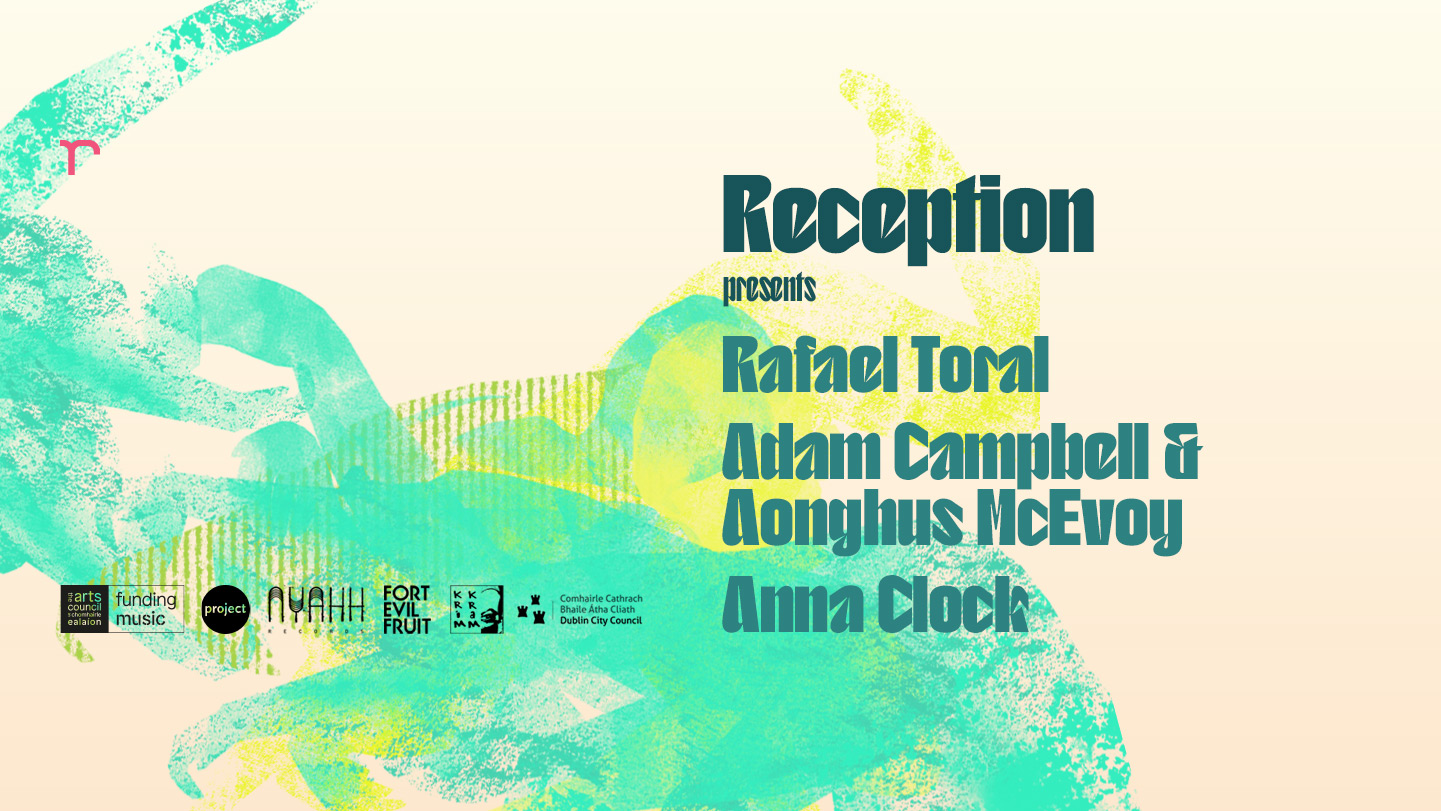
Reception presents Raphael Toral, Adam Campbell, Aonghus McEvoy & Anna Clock
Reception Weekend
16 October 2026
More about Rafael Toral
Born in Lisbon in 1967, Rafael Toral belongs to a generation of artists – Kevin Drumm, Jim O’Rourke, Christian Fennesz, Peter Rehberg, Mika Vainio, Christoph Heemann, Otomo Yoshihide, Oren Ambarchi, etc. – who emerged onto the global experimental music scene during the 1990s, pioneering a new form of electronic music that often drew in equal parts from rock, jazz, ambient music, and minimalism. It was these artists, alongside the broader generation to which they belong, that deserve a great deal of the credit for reinvigorating, both through their own work and championing of the generations prior to them, the field of experimental music following a comparative lull and loss of audience during the ’80s. Of this new, rising generation, Toral was unquestionably among the most influential, via incredibly visionary albums like Sound Mind Sound Body (released by AnAnAnA in 1994 and reissued by Moikai in 1998) and 1995’s Wave Field that combined guitar and electronics to produce sheets of ambience and long tones which represented a new phase in minimal music that would be chased by a near countless number of artists following in his wake of the coming years.
By the early 2000’s, just as the sonic landscape was catching up with him, Toral reached a sense of creative accomplishment and embarked upon a radical new trajectory of work, his “Space Program”, an ambitious long-term project that approached electronic music through the lens of silence, producing a music that is “melodic without notes, rhythmic with no beat, familiar but strange, meticulous but radically free – riddled with paradox but full of clarity and space”, often described as “a brand of electronic music far more visceral and emotive than that of his cerebral peers”.
Over the last seven years, Toral’s work has entered a new phase; a hybrid that utilizes the self-built instruments developed in the “Space Program”, as well as employing the long tones, ambience, and near static textures that defined early works like Sound Mind Sound Body and Wave Field, and encounters him returning to the guitar after more than a decade. (…) The product of three years of experimentation and recording, and arguably amounting to the total distillation of more than thirty years of musical research, Spectral Evolution is quite possibly the most striking and accomplished album we’ve encountered by Rafael Toral to date. It’s an absolute marvel that not only reminds us of the composer’s astounding impact on the sonic
landscape over the decades, but also of the rich sense of possibility that lays ahead of us all.
More about Adam Campbell
Adam Campbell is an artist and musician working with cybernetically inspired performance systems. His work forefronts improvisation and exploration, in which he steers messily entangled networks of space, audience, sound systems and synthesis. Utilising noise, digital synthesis, analog electronics, feedback, volume and occasional vocal audience interaction his performances embrace the unpredictability and instability of high volume non-linearity.
Originally from Scotland, Campbell is now based in Berlin. Along with Tristan Clutterbuck he founded Fancyyyyy; a record label and synthesiser module manufacturer, and the net label FLMPP with Diego Behncke and Nick Klein. He has presented his work globally at Counterflows (UK), Tectonics (UK), Volksbühne (DE), Silent Green (DE), Ochiai Soup (JP), Artsite Soje (SK), Seendosi (SK), La Clínica (MX), Medialab Matadero (ES) and Cafe Oto (UK). Recent and ongoing collaborators include Beam Splitter (Audrey Chen & Henrik Munkeby Nørstebø), Nat Fowler (Novo Line), Fritz Welch, Claude Speeed, Nic Krog and Aonghus McEvoy.
More about Aonghus McEvoy
Aonghus McEvoy is a composer, improviser and guitar player based in Dublin, Ireland. Aonghus’ work moves between collaborations with improvisers, compositions for small ensembles and skewed takes on folk idioms. His use of the guitar ranges from employing traditional techniques to experimental methods to building custom interactive systems for electronics & guitar. Aonghus has performed alongside musicians such as Rhodri Davies, Annette Krebs, Weston Olencki, Sebastian Adams, Cora Venus Lunny, Jon Collin, Ludo Mich, Damo Suzuki, David Maranha, Ailbhe Nic Oireachtaigh, Marcin Pietruszewski, Tristan Clutterbuck, Ricardo Jacinto, Adam Pultz Melbye, David Lacey and has worked with composers such as Conal Ryan, Jack Callahan, Jorge Boehringer and Eva-Maria Houben.
More about
Anna Clock is a musician and sound artist whose solo performances instrumentalise cello, field recordings and electronics within live acts of investigation, inviting the audience to listen to themselves and their environment in new ways. Their latest EP UMBRA was released on Fort Evil Fruit to critical acclaim. The label describes: ‘Between sinewy cello and rumbling vocals, we are invited to eavesdrop on intimate domestic scenes and the steps of a solitary dancer. The hum of waves dragging over rocks and leaves wilting in the rain draws us into an assured quietude, contrasting with moments of fury and ecstasy.’
Alongside their solo work they score film, theatre, radio and installations and are currently pursuing a funded Collaborative Doctoral Award with Royal Holloway University and the Science Museum exploring how we listen to outer space and using live acts of listening as embodied fieldwork for theoretical physics.
They have collaborated, performed and recorded with musicians including Tom Rasmussen (UK), Ailbhe Nic Oireachtaigh (IRL), David Lacey (IRL), Méabh Mckenna (IRL), Lori Goldston (USA), Thruoutin (CN), Roger Kim (USA). Recent commissions include sound and musical works for The Science Museum, Wellcome Collection, Royal Court Theatre, Lyric Hammersmith, Soho Theatre (UK), Times Square, Irish Arts Centre (NYC), Mainz Staatstheater, Dresden Staatsschauspiel (GER), Project Arts Centre (IRL) and Cirko (FIN).
Their audio works have been played on BBC Radio 4, Radio 3, Resonance FM, Radio na Life and RTE Lyric radio.
Funder Credits
Funded by the Arts Council of Ireland
Dates & Times
Friday 16 October
8pm – 10:30pm
Tickets
€30
Space
Space Upstairs
Genres
FestivalMusic
https://vimeo.com/
Support Project Arts Centre and join us in developing the next generation of contemporary artists in Ireland
