Artur Zmijewski, Benoit Maire, Falke Pisano, Joachim Koester, Lee Welch, Maaike Schoorel, Matthew Buckingham, Tine Melzer
Curated by Tessa Giblin
FREE ADMISSION
"…(N)onknowledge: that which results from every proposition when we are looking to go to the fundamental depths of its content, and which makes us uneasy." Georges Bataille
Many of the artistic practices brought together in Nonknowledge remind us of Wittgenstein's fundamental explanation of human perception and comprehension: that we can not conceive of something we do not have the language to describe - "the limits of your language are the limits of your world". By attuning to a language outside of common communication, artists can present an avenue for perception which both reflects on the conditions of knowing, and places the spectator on the opposite side of illumination - in the vast possibilities of nonknowledge.
Many of the artistic practices brought together in Nonknowledge remind us of Wittgenstein's fundamental explanation of human perception and comprehension: that we can not conceive of something we do not have the language to describe - "the limits of your language are the limits of your world". By attuning to a language outside of common communication, artists can present an avenue for perception which both reflects on the conditions of knowing, and places the spectator on the opposite side of illumination - in the vast possibilities of nonknowledge.
The absolute authority that historical artefacts hold - and the web of histories which they both reveal and obliterate, are contested in Matthew Buckingham's Image of Absalon To Be Projected Until It Vanishes. The quasi-mythical crusader from the Middle Ages who expanded and stabilised Danish control over its territories, Absalon was an Archbishop who embodied both the religious and military heroism of the time. A single 35 mm projected slide of the Copenhagen statue of Absalon burns out over the duration of the exhibition, altering the apparently immutable form, bathing the statue in a slow, consuming twilight of symbolism.
As Joachim Koester writes, "the history of the occult is also a history of the obscure". In his photographic series The Morning of the Magicians, he revisits the site of an abandoned and hidden belief system - The Abbey of Thélèma, which was initiated and occupied by the occultist Aleister Crowley and his followers from 1920 - 1923 in Cefalù, Sicily. After evicting the cult in 1923, following a storm of public outrage at the methods of occult worship and tantric sex practiced by Crowley, Mussolini ordered the whitewashing of the psychedelically illustrated surfaces of the Abbey. Painstakingly restored by experimental filmmaker Kenneth Anger in the 1950s for a film which was eventually lost, the frescoes that remain today are a faded yet resilient representation of the belief system evoked within the now dilapidated Abbey.
The practice of Benoît Maire is based in philosophy, from which the artist engages with subject matter - both referential and formal - around him. Interested in the illusory quality that one's 'knowing something' can assert over one's 'seeing something', his simple sculptures are often groupings in which objects are at once reflected and extended through the space of the artwork. In L'objet de singe, négatif (object for monkey, negative), white stones sitting on the floor are reflected in a roughly-hewn Perspex plane, while in Histoire de la géometrie #5 (étude pour l'industrie), pages from books are reconfigured to stage two workers gazing at an image of an icon of industrial progress, and Copernicus' 16th century revolutionary heliocentric diagram of the planets, including earth, orbiting around the sun.
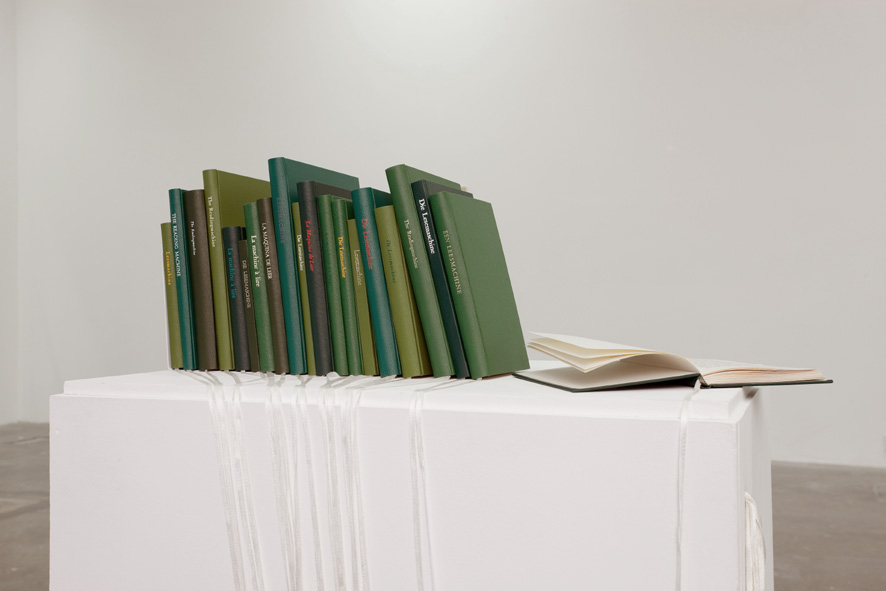
"The first book of the day was read by the time he finished his coffee, served by his wife. The second book he read sitting right there. The third book accompanied him over to the annex building of the library." Tine Melzer's Readingmachine, is a collection of bound novels comprising of the same story in many different languages, and in many different styles. It is like a library of defeated stories which live in the possibility of blank pages, but inevitably succumbs to the failure of its own subject matter: the person who determined to read every book that was ever written.
The paintings of Maaike Schoorel are thick and detailed with layers of colour, texture and gesture, to the extent that any form is barely visible. Pulsing in and out of a recognisable composition, the painted surfaces are full of the all encompassing nature of white light - and confuse the senses like the hum of white noise. In Bed, Schoorel reveals the solitude of an emptied space - even in the dislocated ambiguity with which she paints, there seems to be the remembrance of warmth emanating from the crumpled sheets and exposed duvet. They are strangely liberating paintings, purposefully hovering beyond concrete comprehension, and thus allowing the potential for a multiplicity of intentions in the work - for the painter, but perhaps even more liberally, for the spectator.
Returning to the library as the holder of common history, Lee Welch has embarked on a long archival process to locate and obtain one of the oddest artefacts of the literary cannon - a provocative book by Hugo Vernier which became known through its description in George Perec's The Winter Journey. Combing through the remains of archives and libraries, partially destroyed in WWII bombing, Perec's protagonist Vincent Degraël searched for any remaining evidence of the book he had come across by chance, but which he believed to be the 'blueprint', of every subsequent achievement in 20th century French literature. At the time of his death in a psychiatric hospital, Degraël's quest had never reached fruition - the notebook that he left behind to detail his research was 400 pages long, and the last 392 were empty.
Weaving throughout all of the works in the exhibition, at once uniting them and causing a disturbance to them, are recordings from Artur Zmijewski's Singing Lesson II. Zmijewski brought together a choir of deaf teenagers to sing Bach in St. Thomas Church in Leipzig. In Zmijewski's second piece, William Shakespeare, Sonnets, Huntingdon's sufferer Wojtek Krolikiewcz performs a selection of Shakespeare's sonnets.
"When he speaks in silence, the audience senses the effort of his will struggling with the disintegration of the body and slowly failing, slowly letting chaos take control".
Zmijewski