


Public Talk and Workshop
Public Talk: 6–7.30 pm on 4 December 2019
Venue: Visual Artists Ireland Head Offices
Windmill View House, 4 Oliver Bond Street, The Liberties, Dublin 8
The event is free but booking is essential. Register here.
Workshop with Ines Schaber and Lívia Páldi
4–7 pm on 5 December
Venue: Studio 6, Temple Bar Gallery + Studios
5 - 9 Temple Bar,Dublin 2, D02 AC84, Ireland
The event is free but booking is essential. Register here.
In recent decades, artists, photographers, curators, and critics have caught archive fever, and archives and their processes have often come to dominate discussions in and around photography. This has particular consequences for documentary and artistic practices. In response, Ines Schaber has conducted a series of works that begin with the assumption that an archive is not only a place of storage, but has become a place of production, where our relation to the past is materialised, and where our present writes itself into the future.
In her work, Schaber has examined a set of questions that underlie archival practices. The projects, case studies, writings, and artistic works she has produced seek to trace new or alternate archival practices. The aim of the work has not been to find or create another institutional archive per se, but to develop a practice in which the set of problems that are produced is part of the process we engage in when encountering archives.
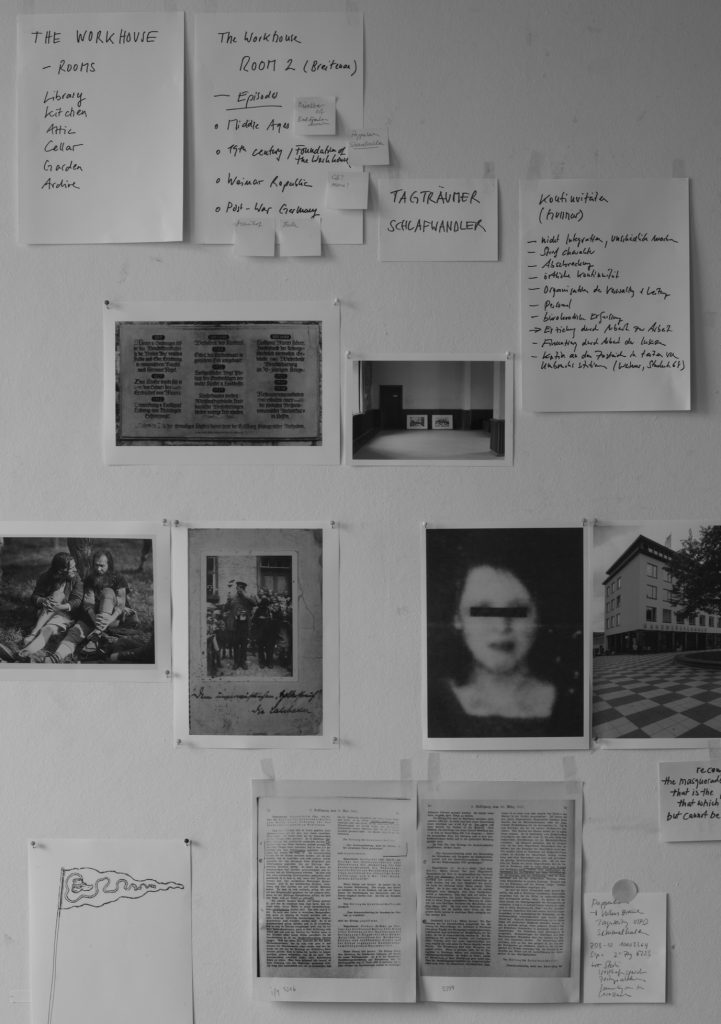
Schaber’s presentation in Dublin will focus on The Workhouse (Breitenau Room), a project that was produced by curator Lívia Páldi in the context of dOCUMENTA (13) in 2012, and conducted in collaboration with sociologist Avery F. Gordon. The piece engages with the history of the former monastery, workhouse, concentration camp, Gestapo camp, and girls’ reformatory of Breitenau, a small village in the vicinity of Kassel, Germany. Over time, Breitenau has confined many people considered extraneous and disposable, subjecting them to a regime of punishment and correction. Consisting of photographs, a curtain, text, and audio files, The Workhouse (Breitenau Room) presents glimpses of ‘fugitive knowledge’ that emerges in and around the site. This knowledge, what Foucault named ‘subjugated knowledge’, contains two aspects: repressed by official knowledge on the one hand; and marginalised or discredited on the other. Searching for traces of this contested knowledge, that might be present in any archive, Gordon and Schaber suggest a different reading of a place like Breitenau.
The Workhouse is also the name for a series of activities and projects (called ‘rooms’) that were organised by Ines Schaber and Avery F. Gordon between 2010 and 2012. Overall, The Workhouse’s activities are broadly concerned with the cultivation of ways of living and working that are independent of, autonomous of, outside of, in opposition to, as an alternative to, or, alongside of but not entirely inside of, the dominant terms of social order. The traditional workhouses, first developed in the late 16th century and reaching their peak in the 19th century, were prisons where (predominantly poor) people, who refused to work or stay put or behave like ‘good’ workers and obedient social subjects, were confined, punished, and corrected. By contrast, the Workhouse activities proposed by Schaber and Gordon were designed to provide a hospitable space for the critical and imaginative thinking/practices of ‘bad’ workers, idlers, strikers, collaborators, runaways, and other individuals who do not want and need conventional ‘correction’ or ‘re-education’.
The Workhouse (Breitenau Room), the second iteration of the series, was installed at dOCUMENTA (13) in the Handwerkskammer (Chamber of Crafts) in Kassel. Parts of it now permanently reside at the Gedenkstaette Breitenau, a memorial, study centre and archives in Guxhagen which engages with the site’s complex history of violence, exclusion and discrimination. The third iteration was presented as a 3-day workshop led by Gordon and Schaber and organised by Pip Day and el instituto for Spatial Practices in Revolution in 2011 in Mexico City.
The workshop will consist of three parts: a general introduction in which participants will introduce themselves and pose questions in relation to archives and archiving; a collaborative discussion of three texts that relate to the notion of subjugated knowledges;* and a conversation in which Lívia Páldi and Ines Schaber will address artworks such as The Workhouse, collaborative work, the challenging exchange between institutional and artistic research and different types of archives and records management, as well as the questions and problems faced by archival/research-based practices today.
*Texts will be provided for participants and should be read in advance if possible.
For more information and availability of texts please contact Lívia Páldi at livia@projectartscentre.ie
