


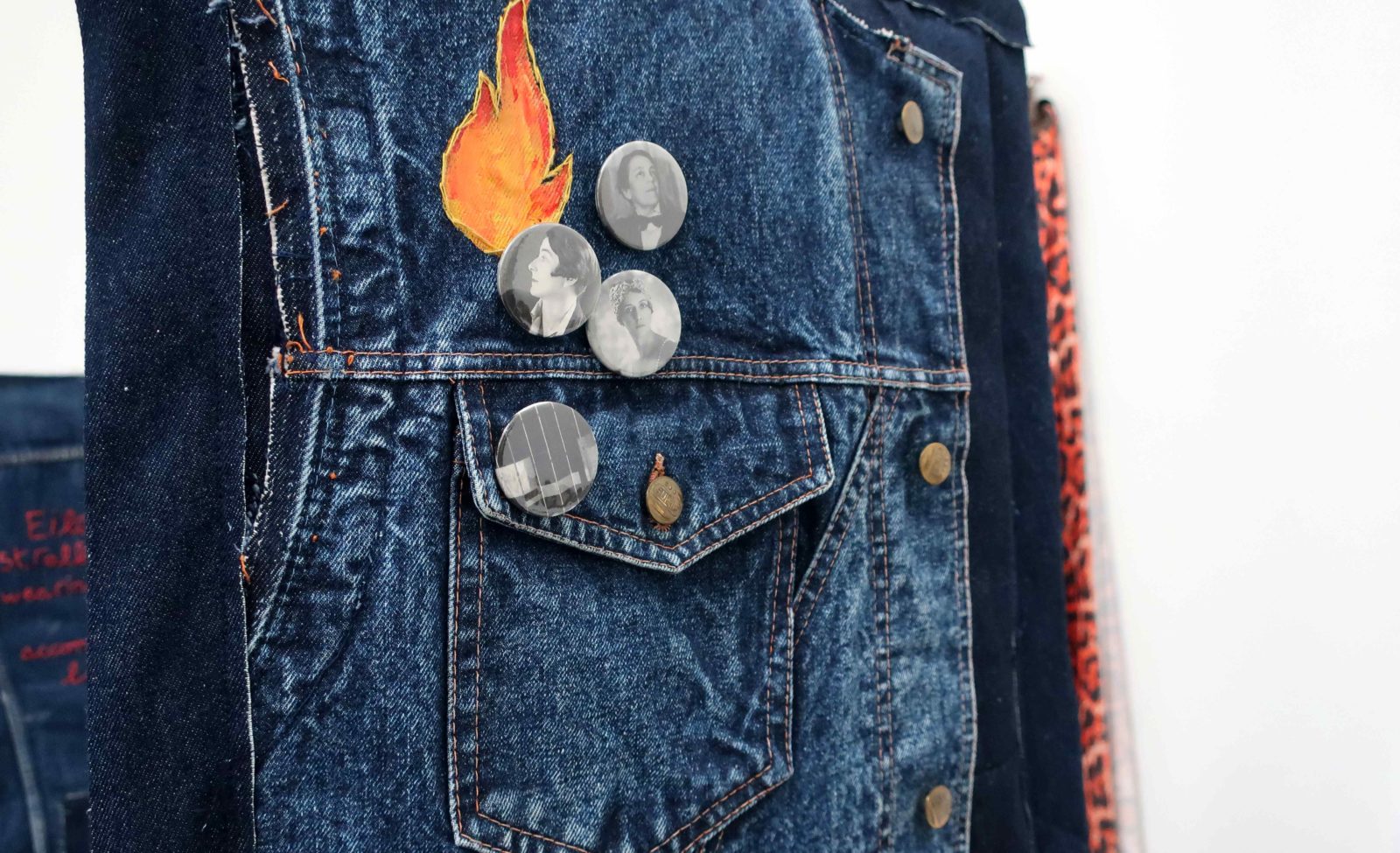
Project Arts Centre is delighted to present a special studio visit with visual artist Emma Wolf Haugh, and a conversation with curator and writer Rike Frank.
Venue: Studio 11 at IMMA residencies, Royal Hospital Kilmainham, Military Rd, Kilmainham, Dublin 8
Domestic Optimism begins with the work and continually expanding legacy of the Irish-born, self-taught, modernist architect and designer, Eileen Gray. A considerable amount of attention has been given to Gray’s work in recent years but, more often than not, the queerness inherent in her life and design is sidelined or ignored. Wolf Haugh is interested in what comes to bear on the construction of legacy and what is and isn’t given historical attention.
Curator and writer Rike Frank has, over the last several years, conducted research on textiles as well as the temporal dimension of exhibiting. This studio visit and conversation between Wolf Haugh and Frank offers a unique opportunity to learn about the research process and preview the making of the new work, while also exploring questions in relation to identity construction in modernist design history, and the legacy built around Gray and her work that erases the close connections she had with other women makers.
The first scene of Domestic Optimism will be presented at Grazer Kunstverein in autumn 2020 followed by the second scene at Project Arts Centre in February 2021.The first part of the project will be exhibited as part of ‘Seized by the Left Hand’ (curated by Eoin Dara and Kim McAleese) at Dundee Contemporary Arts in December 2019.
The trope of the architect-genius was a staple of the Modernist project: hypermasculinised, uncompromising, and embodying a far reaching fantasy of power. Recent work on Gray’s legacy tends to place her as a peculiar ‘other’ within the lineage of the hero-architect, bestowing on her a place in an overtly male dominated, heteronormative canonical history. Gray’s architecture and design were not simply an ‘other’ approach to the Modern Movement, but an extensive critique on the movement itself. Gray was not alone in her thinking and working methods, and much of her work engages with aesthetic strategies used by other female artists active throughout early Modernism. They devised strategies to resist the reduction of a non-heterosexual identity to an emergent pathological lesbian identity: unfamiliarity; liminality; ambiguity; opacity; privacy; and ‘screening’ all offered ways to resist easy communicability or clarity of identity. Much of this experimentation happened in relation to reimaginings of domestic space – in literature, painting, performance, photography, and design. These contributions are often overlooked in Modernist discourse and, as such, the networks of female support and influence are not acknowledged, and thus placing figures such as Gray in working relation to canonical modernism, aligned with heroic modernist figures such as Le Corbusier, Frank Lloyd Wright, and Theo van Doesburg of De Stijl. (Emma Wolf Haugh)
To attend this event please RSVP to livia@projectartscentre.ie
